
Two companies quote your shipment. Both call themselves 3PLs. One owns the truck that will show up; the other will find someone who does. The rates might be within a few dollars of each other, but you are buying materially different things — and the difference shows up on the days when something goes wrong.
What each one actually is
Asset-based carrier
Owns trucks, employs drivers, and holds its own operating authority and insurance. When you book, you are contracting with the company that will physically move the freight. Its capacity is finite — bounded by fleet size and geography — but it is real.
Freight broker
Licensed to arrange transportation without owning equipment. A broker matches your shipment to a carrier from its network, handles the paperwork, and takes a margin. Its capacity is effectively unlimited and its geographic reach is national, but every move depends on a third party it does not employ.
The hybrids
Plenty of companies do both — running their own fleet in a core market and brokering everything outside it. That is a reasonable model, but it means the answer to “is this your truck?” depends on the lane. Ask specifically about your lane rather than about the company.
Where the difference actually matters
Control over execution
An asset-based carrier controls dispatch, driver training, equipment condition, and what happens when a delivery goes sideways at 4 p.m. A broker controls none of that directly. When a receiver rejects a delivery or a driver runs late, the asset-based carrier can redirect a truck; the broker has to make phone calls.
Consistency of service
If you are delivering to the same hotels, galleries, or retail accounts every week, the same drivers learning your accounts is a real operational advantage — they know which door, which contact, which loading window. Brokered capacity rarely produces that continuity.
Liability and insurance
An asset-based carrier is directly liable for cargo in its custody under its own insurance. With a broker, cargo liability typically rests with the underlying carrier, and recovery depends on that carrier’s coverage and cooperation. Ask a broker directly: whose cargo insurance responds, and what are the limits? Our guide to filing LTL freight claims explains why that answer matters before you need it.
Specialized authority
Bonded, TSA-approved, and hazmat-endorsed work depends on credentials held by the actual carrier and its drivers. A broker can find someone with those credentials, but you are trusting the vetting. If your freight regularly touches a port, an airport, or regulated commodities, credentials in-house is a meaningful simplification.
Pricing behavior
Broker pricing follows the spot market and can be excellent when capacity is loose. It can also move sharply when capacity tightens — during peak season, after a hurricane, or around a major event. Asset-based pricing is generally steadier because it reflects the carrier’s own cost structure rather than a daily market.
When a broker is the right call
- One-off shipments into markets where you have no carrier relationship
- Long-haul and cross-country moves
- Surge volume beyond any single carrier’s fleet
- Specialized equipment you need once a year
- Situations where the lowest available spot rate is the priority and timing is flexible
When an asset-based carrier is the right call
- Recurring local and regional lanes
- Time-definite deliveries with narrow windows
- High-value, fragile, or heavily regulated freight
- Deliveries that need consistent handling — galleries, events, hospitality, medical
- Anything where a failed delivery costs more than the freight
- Port and airport work requiring bonded or TSA credentials
Questions that cut through the marketing
- Do you own the trucks that will run my lane, or will this be brokered?
- Are the drivers your employees?
- Whose cargo insurance covers my freight, and what is the limit?
- What credentials do your drivers hold — TSA, hazmat, bonded?
- What happens operationally if a delivery fails at 4 p.m. on a Friday?
- Can I see live tracking, and does it come from your system or the driver’s phone app?
Vague answers to question one are informative in themselves.
How Go LTL is set up
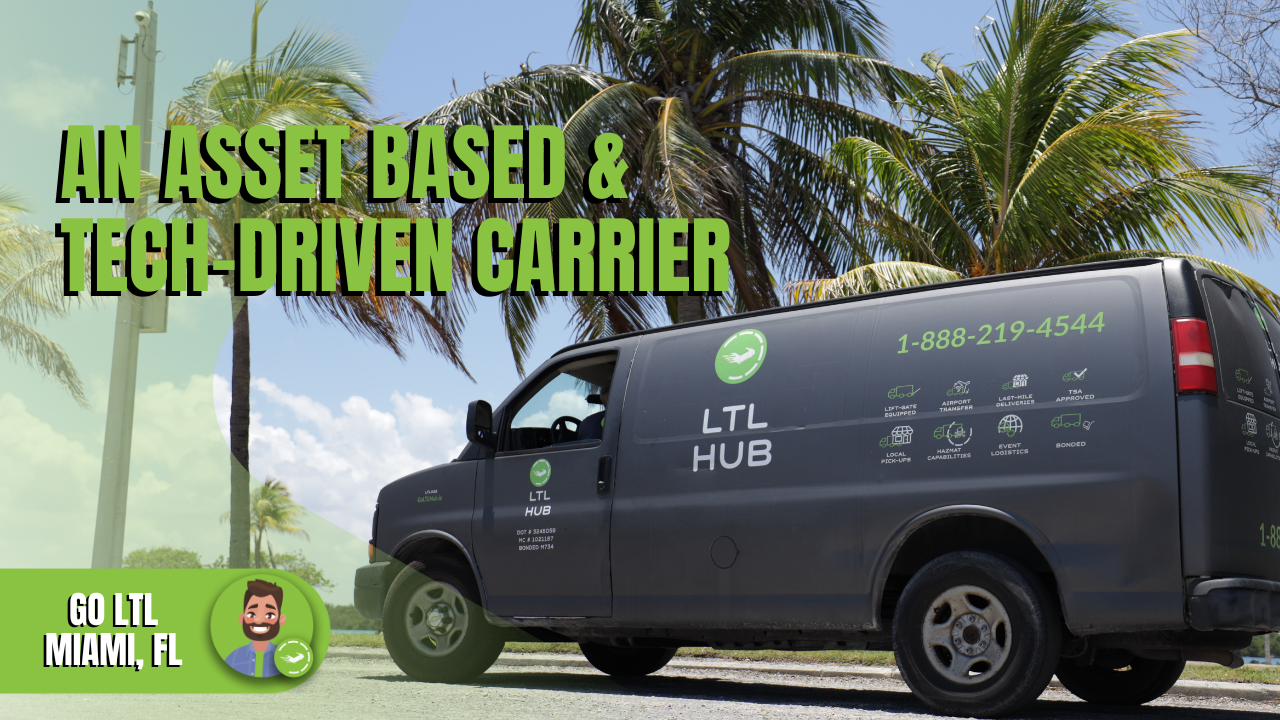
We are an asset-based, tech-driven carrier operating our own fleet of box trucks and dry vans across Miami-Dade, Broward, and Palm Beach. Our drivers are employees who are TSA-approved, bonded, and hazmat-endorsed, and tracking runs through our own platform rather than a third-party app. That structure is why we can commit to narrow delivery windows on event logistics and last-mile delivery work where a missed window is not recoverable. See our full LTL services or request a quote.
Frequently asked questions
Is an asset-based carrier more expensive than a broker?
Not reliably. Brokers can beat asset carriers when spot capacity is loose, and lose to them when it tightens. On recurring local lanes, asset-based pricing is often competitive and considerably more stable, which matters more than a single low quote if you are budgeting.
How can I tell if a company is asset-based?
Ask whether they own the equipment and employ the drivers, and ask for their motor carrier authority. A company operating under broker authority alone does not own trucks. Many companies hold both authorities, so ask about your specific lane rather than the company overall.
Can I use both?
Most shippers do, and it is a sound strategy: an asset-based carrier for recurring regional lanes and time-critical work, brokers for one-offs, long-haul, and surge. The mistake is using a broker for the work that requires consistency, or an asset carrier for lanes far outside its footprint.


Recent Comments