


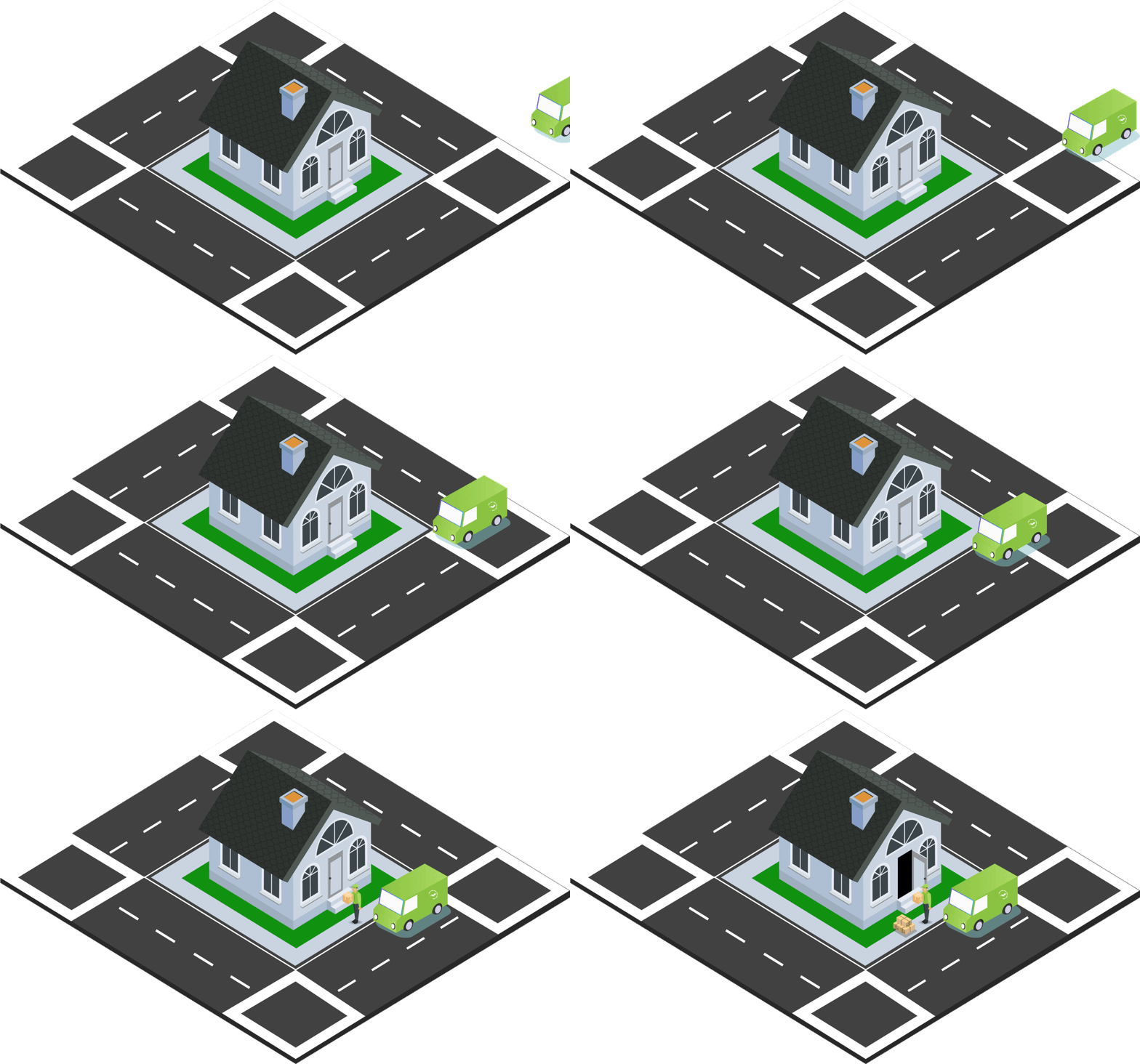
A liftgate is the single most common reason an LTL shipment gets refused, re-delivered, or hit with a surprise accessorial charge in South Florida. The freight arrives, the driver opens the trailer, and there is no dock and no forklift on the receiving end. At that point the pallet is not going anywhere.
This guide explains what a liftgate actually is, when you need to request one, what it typically costs, and how to describe your delivery site accurately so the right truck shows up the first time.
What is a liftgate?
A liftgate is a hydraulic platform mounted to the back of a truck. It lowers from trailer-floor height to the ground so a pallet jack can roll freight off the truck without a loading dock or forklift. Most liftgates on box trucks used for local delivery handle somewhere in the range of 1,500 to 3,000 pounds per cycle, depending on the equipment.
Two things matter beyond the weight rating. First, the platform has physical dimensions, so an oversized crate can overhang and become unsafe to lower. Second, once the pallet is on the ground it still has to be moved with a manual pallet jack, which needs a hard, reasonably flat surface. Gravel, grass, soft asphalt, or a steep driveway will stop a pallet jack cold.
When you need to request a liftgate
Request liftgate service any time the delivery address does not have both a dock at trailer height and equipment to unload. In practice that covers a lot of South Florida:
- Residential addresses — houses, townhomes, and most condo loading areas in Miami-Dade and Broward.
- Retail storefronts in strip plazas along US-1, Biscayne, or Federal Highway that unload at street level.
- Restaurants, salons, and clinics in mixed-use buildings.
- Construction and renovation sites where the dock has not been built yet.
- Self-storage facilities, which almost never have a dock or a forklift.
- Trade show and event venues where you are delivering to a side door rather than the marshalling dock.
You do not need a liftgate if the consignee has a standard dock, a dock leveler, or a forklift on site and someone available to run it. Warehouses in Medley, Hialeah, and Doral usually do. Confirm rather than assume — a warehouse tenant sharing a building may not have their own equipment.
Liftgate at pickup counts too
Shippers forget this one. If you are shipping out of a location without a dock, you need liftgate service at origin. It is billed the same way and is just as likely to cause a failed attempt if it is missing.
What liftgate service costs
Liftgate is an accessorial charge, billed on top of the linehaul. In the South Florida market, liftgate fees on LTL freight commonly land in the $75 to $150 range per stop, and national carriers often apply a minimum plus a per-hundredweight component with a cap. Local courier and final-mile providers frequently price it as a flat add-on instead.
The number that actually hurts is not the liftgate fee. It is the re-delivery. If the truck arrives without a liftgate and cannot unload, you typically pay the failed attempt, the return to terminal, storage while the freight sits, and then a second delivery with the liftgate. That sequence routinely costs three to four times what requesting the liftgate up front would have.
You can see how accessorials fit into local pricing on our South Florida courier rates page, and we quote liftgate explicitly on every LTL shipping quote so it is not a surprise on the invoice.
How to describe your delivery site so the right truck shows up
Most liftgate problems are description problems. When you book, tell the carrier:
- Dock or no dock. Say it plainly. “Ground level, no dock” is unambiguous.
- Unloading equipment on site. Forklift, pallet jack, or nothing.
- Piece count, weight, and largest dimension. A 96-inch crate may not fit a standard liftgate platform.
- Surface and approach. Paved lot, gravel, curb, incline, low-clearance garage entrance.
- Access restrictions. Gate codes, guard check-in, HOA delivery windows, or a street too narrow for a 53-foot trailer. In much of Miami Beach and Coral Gables a 26-foot box truck is the largest realistic vehicle.
- Where the freight actually goes. Liftgate gets it to the ground at the curb or the parking lot. Moving it inside is a separate service.
Liftgate is not inside delivery
This is the most common misunderstanding. Standard liftgate service ends when the pallet is on the ground at the nearest safe point to the entrance. Bringing it through a doorway, up stairs, into a suite, or into a specific room is inside delivery or white glove service, and it is quoted separately. If someone needs to receive freight beyond the curb, say so when you book.
Practical ways to reduce liftgate costs
- Consolidate stops. If you are sending freight to several no-dock locations, a multi-stop local route usually beats paying a liftgate accessorial on separate LTL shipments.
- Break down heavy pallets. Two 900-pound pallets are easier and safer than one 1,800-pound pallet that pushes the platform rating.
- Use a nearby dock. If a customer is close to a facility with a dock, delivering there and running a short final-mile leg can be cheaper than repeated liftgate stops. Our last mile delivery team does this regularly for retailers and installers.
- Ship on the right day. Liftgate stops take longer. Booking into a realistic window reduces the chance of a missed appointment and a second trip.
- Track the truck. Knowing when the driver is 20 minutes out means someone is actually there to sign. Our shipment tracker gives consignees live status.
A quick decision checklist
Before you release the shipment, answer these four questions. If the answer to any of the first three is no, order the liftgate.
- Is there a dock at trailer height?
- Is there a forklift on site during the delivery window?
- Is someone trained available to operate it?
- Is the freight within the liftgate weight and size limits?
Getting this right costs a few minutes at booking and saves a failed delivery. If you are unsure about a specific address in Miami-Dade, Broward, or Palm Beach County, talk to our LTL team and describe the site — we can tell you what equipment the route needs.
Frequently asked questions
How much weight can a liftgate handle?
Most liftgates used for LTL and final-mile delivery are rated between roughly 1,500 and 3,000 pounds per cycle, and the platform size limits how large a single piece can be. Heavier or oversized pieces usually need a forklift, a crane, or a flatbed with different rigging.
Does liftgate service include bringing freight inside?
No. Liftgate service lowers the freight to ground level at the delivery point. Moving it through a doorway, up stairs, or into a specific room is inside delivery or white glove service and is quoted separately.
What happens if I forget to request a liftgate?
The driver generally cannot unload, the shipment is marked as a failed attempt and returned to the terminal, and you are billed for the attempt plus storage and a re-delivery with the correct equipment. It is almost always cheaper to add the liftgate at booking.